Pre-Mortem: How to Do It
This post was translated by AI from the original Norwegian. Read the original version

In my book "Better Decisions," I write about the traps we fall into when making group decisions and what can be done to avoid them. The "pre-mortem" exercise is one of the techniques you can use.
"Pre-mortem" is a technique that helps groups identify potential problems with a decision. Unlike a "post mortem," which is performed after a project is completed to understand what went wrong, a pre-mortem is performed at the beginning of a project to anticipate possible challenges and obstacles.
The exercise involves imagining that a decision went terribly wrong. Participants are then asked to come up with reasons why this happened. This gives the group an opportunity to explore different scenarios and identify weaknesses in the decision. It also provides a platform for discussing and evaluating risk-reducing measures.
This technique is particularly useful for counteracting overoptimism and confirmation bias, which often can lead to underestimation of risk. When I teach courses on group decisions, I recommend pre-mortem as part of the "Balanced Decision-Making" method.
Here is a step-by-step description of the method, using a product launch as an example:
Step 1: Gather the group
Gather all key people involved in the product launch. This may include members from marketing, product development, sales, and management.
Step 2: Define the scenario
Describe the scenario where the product has been launched and has failed. It's important that everyone understands this is a hypothetical situation designed to identify potential risks.
Step 3: Individual reflection
Give all participants a few minutes to write down reasons why the product failed. This should be done individually to avoid groupthink and "confirmation bias." Participants send what they have written to the facilitator.
Step 4: Sharing and discussion
Let each participant share their thoughts one by one. Discuss each point and assess how likely it is that this could happen.
Step 5: Prioritization
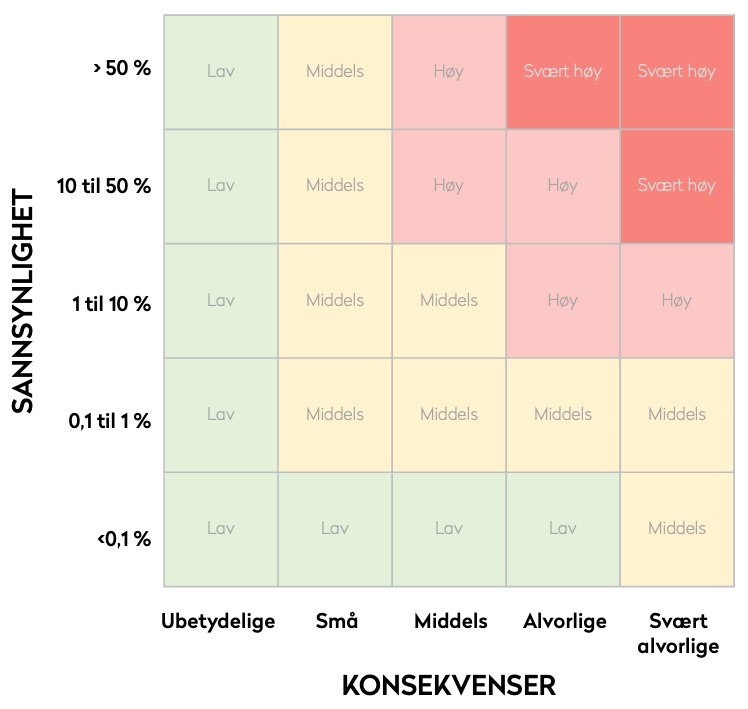
Prioritize the identified risks by probability and impact. This can be done through a risk matrix like this:
Step 6: Develop measures
For each high-priority risk, develop measures to limit or eliminate the risk. Assign responsible persons for each measure.
Step 7: Revise the plan
Include the identified risks and measures in the overall plan for the product launch.
Follow-up and evaluation
In the wake of the decision, regular follow-up meetings should be conducted to assess the progress of risk-reducing measures and make necessary adjustments. Document the process, including which risks were identified, which measures were implemented, and how these affected the project's outcome.
After the product launch, go back to the pre-mortem analysis to see which risks actually materialized and which measures were most effective. This can be valuable learning for future projects.
Recommended reading
Klein, G. (2007). Performing a Project Premortem. Harvard Business Review.
Kahneman, D., & Klein, G. (2009). Conditions for intuitive expertise: A failure to disagree