Book Excerpt: Better Decisions
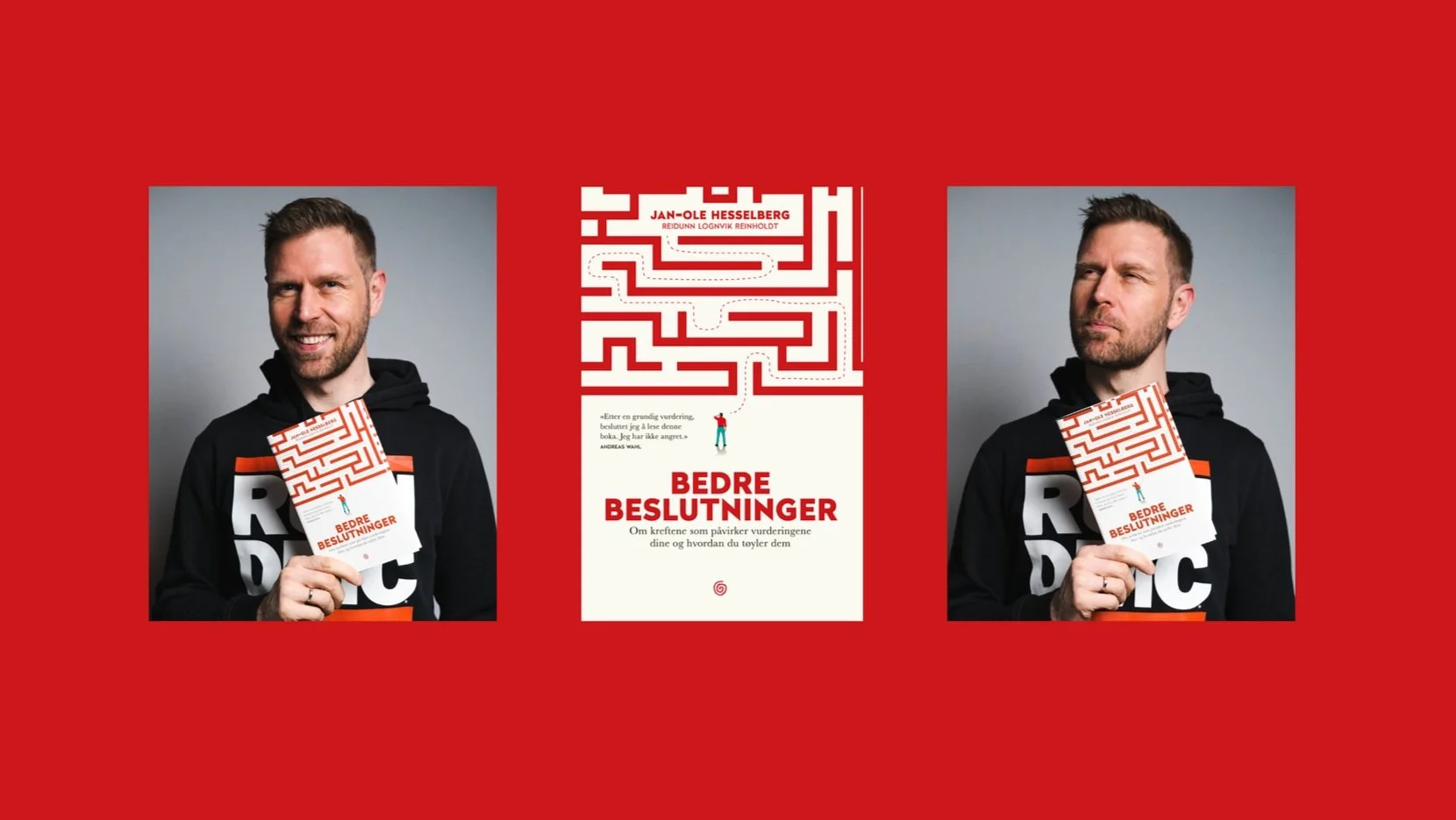
Here you can read the introduction to the book “Better Decisions”. The book is available (in Norwegian) as hardcover, e-book or audiobook.
A couple of years ago I was going to my daughter's track and field Christmas party. It was a two-hour long session with diploma presentations, and I wasn't looking forward to it. Plus, I arrived a little late, and the only empty seat was in the middle of a row. Fact about me: I am 1.93 meters tall. That makes it hard to sneak into anywhere. Plus, I was wearing a big puffer jacket. Annoyed parents moved bags and made room among the chairs while I scrambled into place as carefully as I could.
My daughter got her diploma early in the program, and it was way too hot in the puffer jacket, which was hard to take off without bumping into impatient spectators. It was excruciatingly boring. Sweating, I heard one name after another being called out. But then the vicar of Drøbak, who was leading the event, turned on a screen and announced that now there would be some entertainment. He had made a Kahoot quiz. Relieved, I pulled out my phone. Finally something fun. I went to the website, thought I'd be festive, typed the rap-inspired username “J to the O” and waited as name after name popped up on the screen. Then the quiz started. After a slightly bad start, I did very well. The vicar was soon able to report that I was in third place, but he struggled to pronounce my username. High on three straight correct answers, I shouted out in hip-hop English: “J to the O!” He looked at me blankly and continued the session.
I ended up in a solid third place. Again I scrambled along the row of chairs to collect the prize. I took the stairs up to the stage in one step. The vicar read from the screen:
“In third place, ‘J to the O’.”
As I look the vicar in the eye, I realize something is wrong. He drills his gaze into mine and shakes his head almost imperceptibly. I turn to my left, to the other side of the stage – and there stand the winners of first and second place. Two patient little girls of seven and eight years old. The quiz was obviously not for the adults. And I didn't even come in first place.
I'm pretty sure it's never been as quiet in Smia Flerbrukshus as it was that Saturday. When I got back to my chair, my daughter had melted into her seat with shame.
I work daily on developing decision-making processes to reduce errors of judgment. Yet I interpreted this situation as wrongly as possible. According to research, I am not alone. Most of us, including experienced decision-makers in companies and in socially critical positions, make such errors of judgment. Sometimes it can be embarrassing, but in the vast majority of cases we don't notice it. A consequence of this is that the assessments underlying our decisions are often weaker than they could have been.
In retrospect, I see that there were many signs that I had misunderstood. An insistent elbow from my daughter was the first sign. Another sign was that one of the answer options on the third question was “fart”. Unfortunately, I am equipped with a classic human brain. This brain ignores relevant information and signs of misinterpretation as more primary forces like euphoria, adrenaline and competitive instinct kick in. The brain takes mental shortcuts.
Mental shortcuts are good to have. They allow us to draw lightning-fast conclusions, and they enable us to handle insane amounts of information and a world that bombards us with choices, distractions and temptations. But the same shortcuts also lead to some thought traps, so-called cognitive biases, which make our decisions worse than they could have been.
This is a book about decisions and decision quality. The book is based on a research area that has been under enormous development in recent years. First, we know more than ever before about what blind spots the brain has in the face of choice situations. Second, the field of psychology has undergone a crisis in recent years. Much of what was established knowledge has turned out to be uncertain. It affects what we thought we knew about decision-making processes. Several of the measures that are supposed to ensure good decision-making processes do not necessarily do so.
The book is not primarily for those wondering if they should get a new washing machine. It is aimed at decisions that have major consequences, or processes where smaller decisions are made often, and where they can have great significance in sum.
Maybe you are a doctor considering what diagnosis a patient should get, or an investment advisor evaluating a financial placement. Maybe you are a carpenter thinking about starting your own construction company, or a case worker in an insurance company deciding if someone should get compensation. Or you are part of a large group of product developers who are going to come up with the latest new thing in frozen pizza, or a member of a political group voting on a legislative proposal. Maybe you are a newly hired TV boss and are deciding for the first time what should go on air or not. Or you are an experienced publisher wondering which books to bet on for next year.
Almost no matter who you are and what profession you have, you make decisions that can have major consequences, either for yourself or for others. And we all fall into the same traps.
Decision psychology does not have the solution in every single situation you end up in, but the field can say something about which judgment errors you are vulnerable to, and what you can do to reduce the chance of stepping wrong. For even though decisions can be complex and different from time to time, there is much we can do to facilitate good and stable decision-making processes.
With this book I want to give you confidence in what you have most control over: your own decisions.
The way there goes through the seven chapters ahead of you. You will read about:
- decision styles and finding out which type you are
- that much of what we think we know about decisions is wrong
- thought traps and the mental shortcuts that make us end up in them
- “noise” in our assessments, a problem that is bigger than you realize
- decisions in groups and how wrong it can go
- the best people and how they think
- the seven steps to better decisions
You will read about both my own and others' research, documented in the reference list you will find at the end of the book. Some of my research is based on simple online tests, which you can find at www.beslutninger.no. Feel free to take them before you start the first chapter. It is not necessary, but it can make you a little wiser and at least more curious.
In English, this field is called “judgment and decision making”. What I write about deals mostly with both judgments and decisions, and for the sake of simplification use “decisions” about both parts. It can still be useful to keep in mind that these are really two different processes, even though they are closely linked. Prior to many decisions comes an assessment, but not always. And even though some assessments end in a decision, not all assessments do.
You will read about many of the most central studies from this research field, but the book is not a systematic review of all research in the field. The research has gone through my filter. A filter that reflects my preferences and interpretations.
Happy reading.